Quick-Release Top Handle Grip (1/4″ Mount) Rig Guide

Quick Release Camera Top Handle Grip with 1/4” Mount
A top handle is one of the simplest upgrades that can make a compact camera rig feel easier to control. It adds a centered carry point, improves leverage for small handheld moves, and makes low-angle operating less punishing on your wrist. When that handle uses a quick-release connection, it also speeds up the constant gear reshuffling that happens on real shoots—moving from tripod to handheld, fitting the rig into a bag, or stripping it down for gimbal prep. For more guidance, see Peak Design Clutch review – Ricks Reviews.
This guide explains what a quick release camera top handle grip with a 1/4” mount does, how it typically interfaces with cages and top plates, and what to double-check so it stays secure and comfortable when you’re actually rolling. For further reading, see grip, rig & stabilizer equipment – Austin Film Society.
What a quick-release top handle does on a camera rig
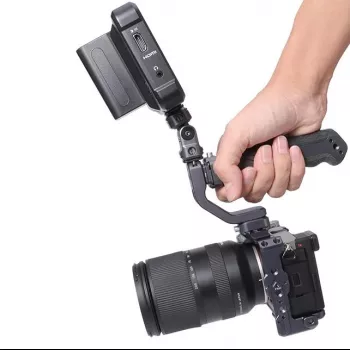
A top handle changes how you hold and steer your rig. Instead of gripping a side handle or pinching the cage, you get a higher, more centered grip point that can steady movement and make repositioning more predictable.
- More controlled handheld movement: A centered grip helps with starts/stops, subtle pans, and quick reframes without the rig twisting as easily.
- Easier low-mode operation: Carrying the camera near the ground by a top handle keeps the wrist closer to a neutral angle, which often feels steadier for tracking shots.
- Faster rig changes: Quick-release designs reduce the time spent loosening knobs, sliding plates, or removing accessories just to fit a case or mount a different support.
- Broad compatibility with 1/4” mounting: The 1/4”-20 thread is widely used across cages, plates, and accessory mounts, so it’s easier to integrate into mixed-brand builds.
How the 1/4” mount fits into common camera and cage setups
The 1/4”-20 “tripod thread” is a long-standing standard for camera support gear and accessories. If you want a deeper technical overview of common camera screw sizes, see the reference on the 1/4”-20 and 3/8”-16 tripod screw standards.
In practice, many camera cages and top plates include multiple 1/4”-20 threaded holes. A top handle usually mounts to the cage/top plate rather than directly to the camera body—this helps distribute load, improves balance, and reduces stress on the camera’s own threaded points.
If your handle uses a quick-release clamp/plate, confirm the mating part on your rig matches that quick-release style and that the contact surface is flat and stable. Also consider where the handle sits relative to the rig’s center of gravity; the closer it is to the balance point, the less the rig wants to twist when you lift it.
Mounting checklist for a secure top-handle setup
| Check | What to look for | Why it matters |
|---|---|---|
| Thread standard | 1/4”-20 compatibility | Prevents cross-threading and loose fit |
| Mounting surface | Flat, solid top plate/cage area | Reduces wobble and rotation |
| Anti-rotation support | Pin/slot, locating points, or high-friction contact | Keeps the handle from twisting when lifting |
| Clearance | Space for fingers and accessories (mic/monitor/EVF) | Avoids cramped handling and cable strain |
| Balance | Handle positioned near rig center | Improves comfort and stability during takes |
Quick-release vs fixed handles: when speed matters
Both quick-release and fixed handles can be stable—what changes is how quickly you can reconfigure the rig.
For documentary, event, and run-and-gun shooting, shaving minutes off re-rigging can be the difference between getting the moment and missing it. For studio builds that rarely change, fixed can be plenty—quick-release mainly adds convenience when the setup evolves throughout the day. For more rigging and support ideas, B&H’s learning hub has useful primers on camera support and video workflows at B&H Explora (Video).
Comfort and control: grip shape, height, and hand placement
Practical setups for common shooting styles
Care, safety, and avoiding common mounting mistakes
Quick Release Camera Top Handle Grip with 1/4” Mount: overview and best-fit use cases
The Quick Release Camera Top Handle Grip with 1/4” Mount is designed for creators who want a top carry/operating handle that mounts via a 1/4” interface and can be removed quickly when the rig needs to change form. It’s a strong match for compact cages and lightweight video rigs where fast reconfiguration is part of the day—low-angle shots, quick pickups, and smoother transitions between handheld operation and packed transport.
If you’re also building out an efficient post-production setup, the Wireless Hot-Swappable TKL 87-Key Mechanical Gaming Keyboard RGB Backlit is another in-stock option that fits neatly into smaller editing desks thanks to the tenkeyless layout.
FAQ
Will a 1/4” mount top handle fit most camera cages?
Many cages and top plates include multiple 1/4”-20 threaded holes, so this mount style is broadly compatible. Confirm the thread type is 1/4”-20 and make sure the handle’s quick-release interface matches the clamp/plate style used on your cage or top plate.
Is a quick-release top handle secure enough to carry a rig?
It can be, as long as the quick-release mechanism is fully engaged, the mounting surface has solid contact, and the setup includes anti-rotation support where possible. Routinely check for any play and avoid lifting unusually heavy builds from a single mounting point.
What’s the benefit of a top handle for low-angle filming?
A top handle improves wrist ergonomics and gives you a stable grip when operating close to the ground. It also makes it easier to track movement and reposition quickly compared with gripping the side of a cage.










Leave a comment